


 Contact
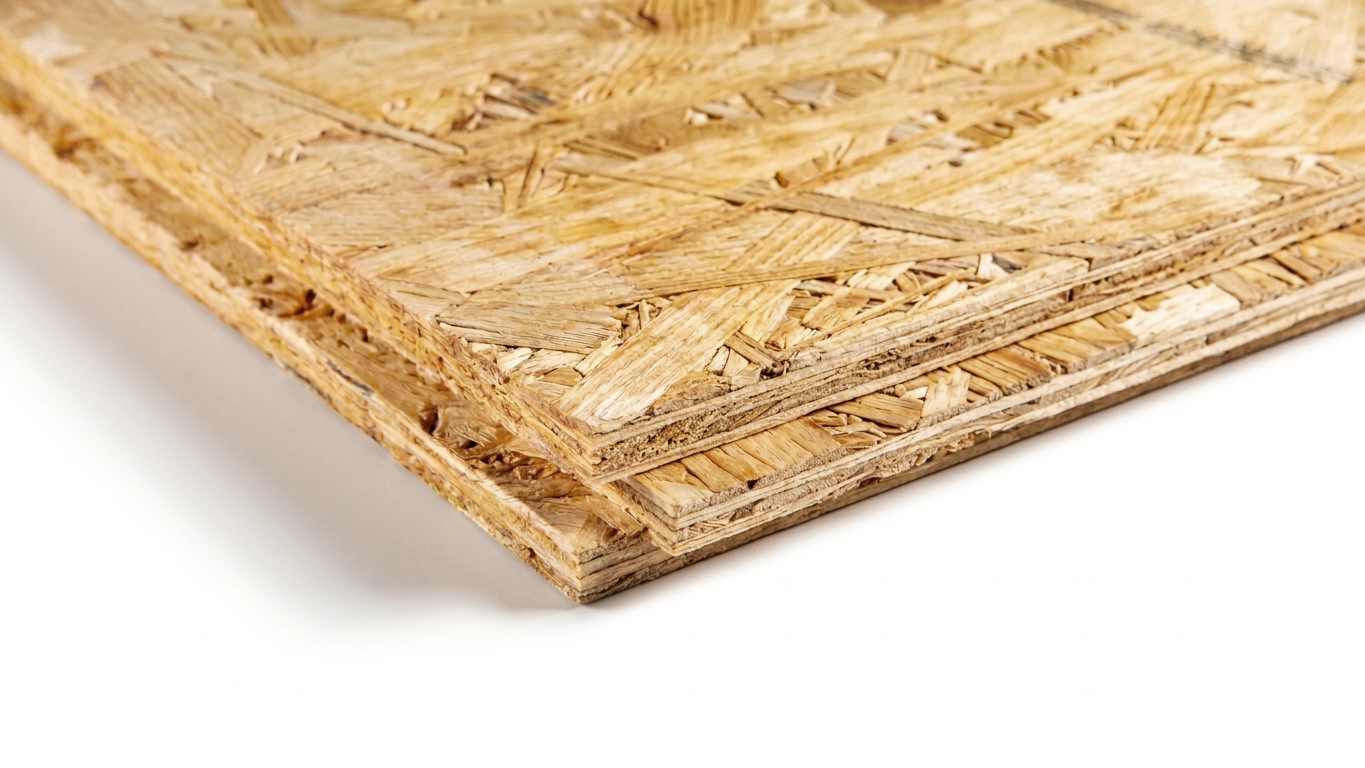
OSB3 board, cutter 12 mm 2500x625 / 1.5625 m2, 59 / pallet
 Wróć do kategorii: Towary jednorazowe
Files to download
Possible delivery options
 Odbiór własny SzczecinOdbiór własny Bydgoszcz

 Add to clipboard

Any questions?
 Description
 < / p>


OSB (Oriented Strand Board) is a wood-based panel consisting of the strands of wood, which are bonded together with the synthetic resin, are pressed together in layers. In the outer layers, the strands are generally oriented longitudinally in line with the length of the panel, while in the middle layers, the strands are generally oriented in the transverse direction. Composition: The wood species used in the production of OSB include both softwood (spruce, pine) and some hardwood. The wood strands are cut tangentially from stripped logs that are held longitudinally against the rotating knives. The web of strands produced is typically about 75 mm wide and unfolds during transportation to form individual strands which are typically 100 mm long along the grain and from 5 to 50 mm long along the grain. After drying, these strands are sprayed with a synthetic resin binder. Typically used types of resins include phenolic formaldehyde (PF), melamine fortified formaldehyde (MUF) or isocyanate (PMDI), all of which are moisture resistant binders. It is common in Europe to use a combination of binders, typically PMDI would be used in the core and MUF in the face layers, and this has the advantage of reducing press cycles while giving a bright appearance to the panel surface. Appearance: OSB is easily identified by its relatively large and long strands of wood. The orientation of the surface bands is not always visually visible, especially in small cut sections of the panel. The main advantages of OSB lie in its mechanical performance, which is directly related to the geometry of the strands and their orientation in the panel. Although the OSB board consists of relatively large strands of wood, its surface is relatively smooth and can be further improved by sanding without losing the aesthetic character that is characteristic of OSB boards. OSB boards vary in color from light straw to medium brown depending on the type of wood used, the resin system used and the pressing conditions used. It does not contain knothols, core voids or points of weakness. Density, weight and sheet size: The density of the panels (and therefore the weight of the panels) varies depending on the product, which is influenced by the wood species and the manufacturing process. Typical densities are 600-680 kg / m3. For example, a panel measuring 2400x1200x12 mm weighs about 20 kg. The commonly available panel sizes are 2440 x 1200 mm, 2440 x 1220 mm and 2500 x 125 mm in thicknesses from 6 mm to 40 mm. Other sizes are available or can be made to order. The panels are produced with both square and grooved (T&G) edges. Application: Due to its high mechanical properties and the orientation of the strands in the slabs, OSB is particularly suitable for load-bearing applications in construction and is widely used for flooring, roofing and wall sheathing, but there is also a wide range of other applications where it can be used OSB as a panel product based on wood. Various grades of product are available for different loading levels and different environmental conditions. Guidance on the use of OSB in these load-bearing applications is given in ENV 12872 and EN 13986. OSB is a high-quality, precision-engineered product that can meet the same applications and load conditions as plywood, and in some cases a thinner OSB panel can be used in this way reducing costs. Large amounts of OSB boards are also used for sarking and industrial packing as well as for display cabinets and pallet tops.
Translations of product names and their descriptions have been translated using Google Translate.
Related products

Storage: 70 piece

Storage: 566 piece
Storage: 135 piece
Storage: 331 op.

Storage: 31 op.